Pages

Gambit Communications® Network Simulation

Gambit Communications® is a provider of tools for simulating servers, networking and storage devices.

Network management software

MIMIC Simulator for testing your network management software.

Network Management Apps

MIMIC Simulator for testing your network management software. SNMP Simulation.

MIMIC Web Simulator

Create a large virtual lab with Gambit Communications.

IOS Simulator

IOS based apps Using MIMIC Simulator.

Friday, 26 December 2014

Employ Network Management Software for Your Business Success

Many companies these days rely on the internet technology for the success of their business. This is accomplished through the assistance of appropriate software and the appropriate updating of each on a regular basis. However, the complicated part is the installation of the networks particularly when accomplished manually.

http://www.gambitcomm.com/site/products/mimic_files/mimic2.gifProblem could begin when some affiliates of the working staff mess up the network configuration which could certainly affect the overall updates. This can bring unbalanced update system to the organization. In such circumstances, the network management software can help the company to get out of the trouble.

Network management application is such a great tool for the network change management responsibilities of each organization. It can’t be prevented that once in a while there’d be adjustments in the configuration & assignments of the network. Network management software can be a great solution to get away from probable errors.. It can assist in correctly applying the configuration without compromising its accuracy. Just think how much investment and money would be wasted away for each blunder done with configuration. Thus it’s essential that you get it right from the firstt attempt.

What’s great about network management application is that it not only assists in the task of new network configuration but in correcting issues taking place within the network as well. It helps in setting up and fix the entire network and put a stop to any type of issues that might slowdown the company’s performance.
http://www.gambitcomm.com/site/products/images/netflow-auditor.jpgNetwork management application is very easy & simple to comprehend and implement because of its user-friendly interface. This can offer you with the perfect reports that you require to be able to access suitably.

  
Follow Gambit Communications on:-
 
facebook twitter linkedin

Friday, 19 December 2014

Monitor Server Health through SNMP

Server monitoring is extremely vital to essential IT infrastructural maintenance. An excellent monitoring system doesn’t just create alarm in reply to the important events but also offers the analytic devices to operate on the advanced scenario in IT domain. In the IT industry, some standard protocols are employed for server monitoring purposes. Generally used protocols are ICMP, SNMP, WMI, etc. By far SNMP is the most common choice and extensively employed platform for server monitoring. SNMP employs a general community string to check devices. When the string is verified, it offers useful info about the physical health of server and other devices.

SNMP - A brief introduction:

SNMP (Simple Network Management Protocol) is a standard protocol and employed to supervise servers and network devices on IP network. The services of Simple Network Management extend to other devices like printer, switches, routers, etc. This protocol has a widespread use in network management systems. SNMP comprises several standard features: an application layer protocol, a schema, a set of data objects for complete administration of the total network.

Working process of SNMP?

mimic_viewOn the managed system – which describes the system configuration – the management data is depicted in form of variables. Once represented, the management data – in their latest format are monitored and occasionally changed by the managing applications. In case of general SNMP uses, the administrative manager monitors a horde of services and hardware on that system. Each of the administration systems has an agent software. This agent takes the responsibility of sending crucial info to the manager via SNMP.

Why SNMP is the best protocol to monitor server:

SNMP is the best choice when it comes to server monitoring tool and there’re several reasons behind it. Simple Network Management Protocol sends easy-to-understand info to the network managers. Such a quality aids in proper administration of several devices with the assistance of common network administration tools. Only a single interface is adequate for the reason of device administration through SNMP. It is the most efficient and best possible device administration system that makes sure of correct communications amid the management stations and agents from several vendors. The complete network analyzer – a crucial device of server monitoring through SNMP provides timely analysis. On strength of some crucial tools, SNMP does many important tasks comprising network interface planning, RAM space checking & provision of back-end-support system.


Server monitoring through SNMP uses the different tools of network administration to get the ideal piece of info regarding the network of blockage. Since the whole monitoring system is based on performance reports from the tools, you can always anticipate SNMP to work appropriately towards server monitoring.
Follow Gambit Communications on:-
facebook twitter linkedin

Tuesday, 2 December 2014

What is Network Monitoring?

The term network management and network monitoring are both often utilized in IT (Information Technology) industry. So what is network monitoring? Well, network monitoring refers to the practice of control function of a computer network employing specialized management tools. Network monitoring programs are employed to make sure accessibility and overall performance of hosts and network services. Typically, these systems are used on large-scale corporate and university IT networks.

Key aspects in network monitoring:

netflow_sim_constant1A network monitoring software is capable of spotting and reporting malfunction of devices or connections. Normally, it measures the CPU utilization of computers, the network bandwidth use of links, and other features of operation. Often it will send messages over the network to each host to make sure if it is responding to requests. When malfunctions, insufficiently slow reaction, or other unanticipated behaviour is spotted, these systems send supplementary messages named “alerts” to selected locations such as an email address, a management server or a telephone number to inform system administrators.

MIMIC NetFlow Simulator:

MIMIC NetFlow Simulator creates a lab full of devices based on Cisco® NetFlow, Juniper® J-Flow, IPFIX, and sFlow data to completely evaluate and test your Flow monitoring, management and analysis applications. Also, MIMIC Network Simulator tool allows developers to perform real world, integrated device simulations. The most common uses of MIMIC NetFlow Simulator are in development and testing, evaluation, trade shows, sales demos and training environments.

Follow Gambit Communications on:-
 
facebook twitter linkedin

Wednesday, 26 November 2014

What Can SNMP Do To Manage Your Network ?

So you have decided to get a better grip on your network? Maybe you are looking at establishing some screening. But then you find out you require to configure this thing named SNMP, and that is when the issue start. There’re things to configure that you never have heard of: MIBs, OIDs, traps, polling, informs and versions.

In this article, you’ll get to know the basics, and observe how it can assist you make your network more dependable and simpler to manage.

What is SNMP anyway?

iccnalab-menuSimple Network Management Protocol (SNMP) is a standard method of monitoring software and hardware from about any manufacturer, from Cisco to Microsoft. SNMP needs only a couple of essential components to function: a management station & an agent.

First, the management station - It is simply an application that gathers info from your network and shows you status of each managed device. Most of the management stations will ask your network for info on a regular basis. Management stations range from very simple to extremely difficult.

Usually, simple software is feature-limited, but can be avail freely and effortless to configure. At the same time, complex software can handle your total network and give you a full control. Also, they’ll perform things such as generate reports, do inventory, and send SMS or email alerts when systems fall short.

What Simple Network Management Protocol can do?

SNMP is extremely simple, yet very effective. It has the capability to help you handle your entire network by:

• Offer read or writer capabilities – for instance, you could employ it to reconfigure IP address or set thresholds.

• Collect error accounts into a log, helpful for troubleshooting & recognizing trends.

• Collect info on how much bandwidth is being utilized

• Email an alert when your servers’ disk space is low.

• Monitor the CPU & memory use of your server, alert when thresholds are surpassed.

• Passive SNMP simulator devices can send alerts to monitoring station on fault conditions and help you test your management station.

Follow Gambit Communications on:-
facebook twitter linkedin

Monday, 24 November 2014

Basic Components of SNMP and Their Functionalities

SNMP is one of the most widely accepted protocols to manage and monitor network elements. It’s an application-layer protocol by the IAB (Internet Architecture Board) in RFC1157 for exchanging administration info from network devices. In this article, we will take a good look at SNMP’s basic components & their functionalities.

Simple Network management Protocol consists of SNMP manager, Managed devices, SNMP agent, Management Information Base (MIB).


SNMP manager:
A manager is a separate unit that’s accountable to communicate with the SNMP agent on network devices. This is usually a software installed on a PC or a server to operate one or more network management systems.

Key functions of SNMP manager include:
• Queries agents
• Gets responses from agents
• Locates variables in agents
• Accept no synchronous events from agents
Managed devices:
A managed device is the part of the network that needs some type of monitoring and management, for example, switches, routers, workstations, servers, UPSs, printer, etc.
SNMP agents:
The agent is an application that is packaged inside the network element. The agent gathers the management information database from the device locally and makes it accessible to the SNMP manager, when it’s asked for. These agents could be specific or standard to a manufacturer.

Key functions of SNMP agent:
• Collects management info related to its local setting
• Stores and retrieve management info as defined in the Management Information Base (MIB)
• Acts as an alternative for some non–SNMP manageable network node
• Indicates event occurrences to the manager

Management Information Base (MIB):

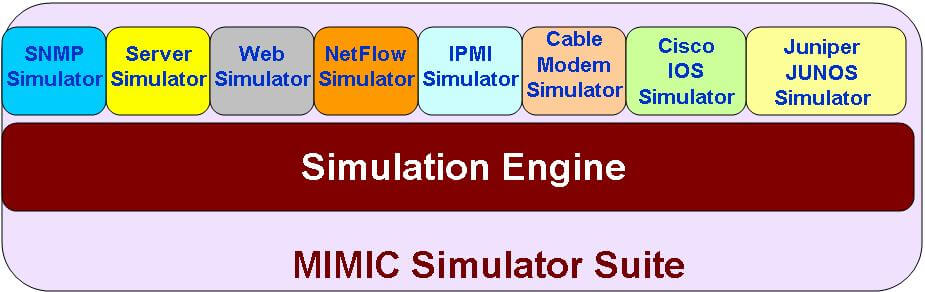
Simulator Suite


Each SNMP agent retains an information database explaining the managed device configuration. The SNMP manager employs this database to ask the agent for precise info and further interprets the info as required for the NMS (Network Management System). This commonly allocated database between the Manager and Agent is named Management Information Base or MIB.

Usually, these MIBs contain regular set of numerical and manage values characterized for hardware nodes on a network. Also, SNMP allows the expansion of these regular values with values specific to a particular agent via the utilization of private MIBs.

In brief, MIB files are the set of parameters that an SNMP Manager can request the agent. Agent assembles these data locally and stores them as described in the Management Information Base. Therefore, the SNMP manager must be attentive of these standard & private queries for every kind of agents.


Follow Gambit Communications on:-
facebook twitter linkedin

Tuesday, 21 October 2014

SNMP – Overview and Basic Concepts

Simple Network Management Protocol or SNMP is an Internet Standard Protocol for managing tools on IP networks. Devices that generally support SNMP comprise of switches, routers, servers, printers, workstations and modem racks. SNMP is mostly used in network management systems to scrutinize network-connected devices for states that call for administrative consideration. SNMP is a part of the IPS (Internet Protocol Suite) as classified by the IETF (Internet Engineering Task Force). Simple Network Management Protocol provides managing data in the form of variables on the controlled systems, which explain the system configuration.

SNMP standards:

Introduced in the 80s, the original edition of SNMP, SNMPv1, lack some crucial functionality & only worked with IP or TCP networks. An enhanced version for SNMP, SNMPv2 was introduced in 1992. Even though Simple Network Management Protocol had many security issues, several networks remained on the SNMPv1whilst others implemented SNMPv2. Recently, the SNMPv3 version was introduced to address those issues with SNMPv1 & SNMPv2 and allowed managers to move to one regular SNMP standard.

Overview & basic concepts of SNMP:
mimic2
In general SNMP uses, one or more administrative computer systems, known as managers, have the responsibility of monitoring or controlling a group of devices or hosts on a computer network. All managed systems execute a software module called an agent which provides information using SNMP to the manager. SNMP agents assign management data on the controlled systems as variables. Also, the protocol allows active management responsibilities, such as revising & employing a new configuration via remote adjustment of these variables. The variables available via SNMP are prearranged in ranking. These ranking, and other meta data are included in MIBs (Management Information Bases).

An SNMP-controlled network comprises of three crucial elements:

• Managed device
• Agent software that runs on controlled devices
• NMS or Network management station application that runs on the manager

MIMIC SNMP simulator:
 

MIMIC SNMP Simulator creates a network of up to 100,000 SNMP-manageable devices. You can create any SNMP-based device with any number of public or private MIBs to run a large variety of device configurations with your SNMP management application. It lets you generate thousands of traps to simulate disaster scenarios.

Follow Gambit Communications on:-
 
facebook twitter linkedin

Sunday, 19 October 2014

Network Monitoring – An Overview

Network monitoring is needed in a system that persistently scrutinizes a computer network for sluggish or weakening components. It informs the network administrator via SMS or email in case of outages. It’s a part of network management.

wca_2006_winner
Whilst an intrusion-detection system scrutinizes a network for dangers from the exterior, a network monitoring system scrutinizes the network for issues sourced by overloaded or crashed servers. For instance, to know the status of a web server, monitoring software might sporadically send an HTTP request to obtain a page. For e-mail servers, a text message might be sent via SMTP & recovered by POP3 or IMAP.

Generally measured standards are response time, accessibility & uptime, though both reliability and consistency measures are beginning to obtain popularity. The extensive incorporation of WAN optimization tools is having negative effects on most of the network monitoring devices – particularly when it is about observing precise end-to-end response time since they restrict round trip visibility.

Internet server monitoring


Monitoring an internet server denotes that the owner of the server always notified if one or more of services go down. Server monitor could be internal, for example, web server application verifies its status and informs the proprietor if some services go down, and external, i.e. some web server monitoring firms verify the service status with certain regularity. Server monitoring can cover a test of system measures, such as memory usage, CPU usage, disk space and network performance. Also, it can comprise application monitoring, such as verifying the procedures of programs such as Nginx, Postgres, Apache, MySQL and others.

External monitoring is more dependable, as it keeps working when the server totally goes down. Also, manyserver monitoring tools have performance benchmarking, alerting abilities & the capability to connect certain entrances with automatic server responsibilities such as performing a backup.

Follow Gambit Communications on:-
 
facebook twitter linkedin